

TL;DR:
- Proper vehicle maintenance and emergency gear are essential for safe long-distance travel.
- Comfort and organization accessories enhance driving experience but should complement vehicle prep.
- Prioritizing vehicle inspection over gadgets ensures reliability and avoids being stranded.
Road trips feel deceptively simple until you’re stranded with a dead battery 200 miles from the nearest town. The truth is that road trip gear goes far beyond a packed suitcase and a full tank of gas. It’s a strategic combination of vehicle preparation, safety tools, comfort upgrades, and organization systems that work together to keep you moving confidently. In this guide, we break down every major gear category, explain why each one matters, and give you the practical knowledge to select the right accessories before your next long drive.
Table of Contents
- What is road trip gear? A comprehensive breakdown
- Safety essentials: Preparing your vehicle and packing emergency gear
- Comfort upgrades: Accessories to eliminate fatigue and stress
- Organization tools: Mastering car storage and preventing clutter
- Advanced and specialty gear: Weather, terrain, pets, and special circumstances
- Rottalab’s take: The truth most road trippers miss about gear
- Find your ideal road trip gear right here
- Frequently asked questions
Key Takeaways
| Point | Details |
|---|---|
| Comprehensive gear matters | Road trip gear covers safety, comfort, and organization—not just packing bags. |
| Safety first | Reliable vehicle prep and complete emergency kits are crucial for every long journey. |
| Comfort upgrades reduce fatigue | Accessories like seat cushions and window shades make a notable difference for drivers. |
| Organization prevents hazards | Proper cargo tools help avoid clutter and keep your ride safe. |
| Adapt to conditions | Special gear may be necessary for extreme weather, off-road travel, or family needs. |
What is road trip gear? A comprehensive breakdown
Now that you’re oriented on the importance of road trip gear, let’s break down exactly what it includes and how each type impacts your journey.
Car accessories that improve safety, comfort, and organization define what road trip gear truly is. It’s not a single product category. It’s a layered system covering four core pillars: vehicle maintenance, emergency response, comfort, and organization. Each pillar addresses a different failure point on a long drive, and neglecting any one of them creates a gap that can turn a minor inconvenience into a serious problem.
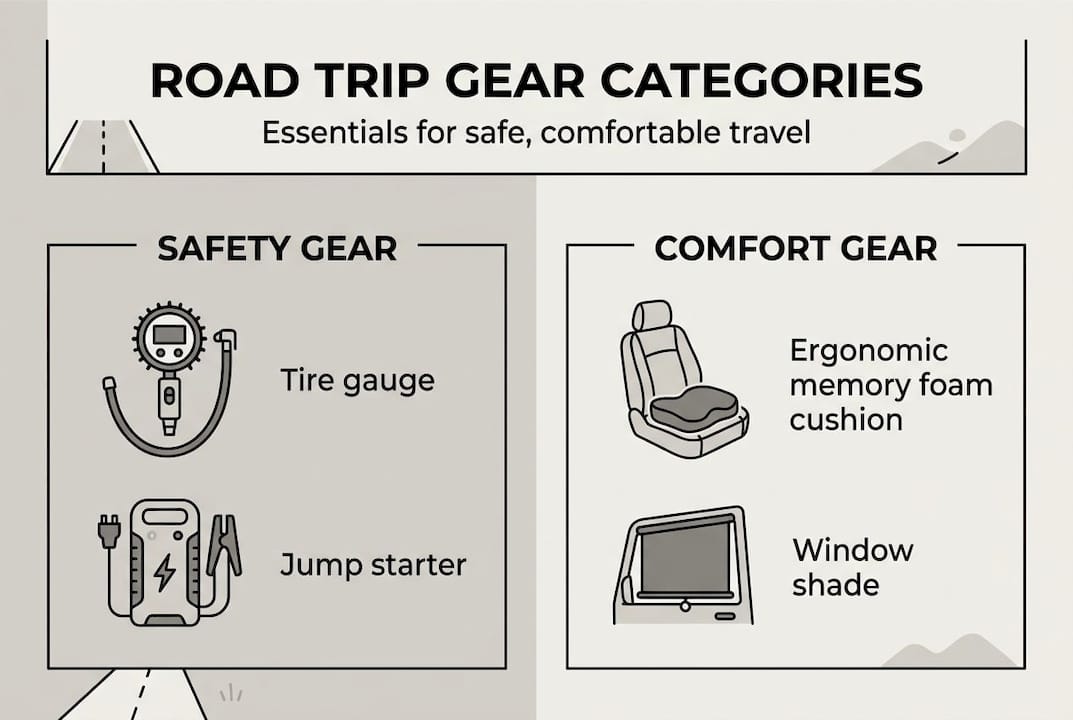
Vehicle maintenance gear covers the basics that keep your car running. Think tire pressure gauges, spare tires, and fluid top-up kits. These aren’t glamorous, but they’re the foundation. Emergency gear steps in when something goes wrong: a portable jump starter, road flares, a first aid kit, and a basic tool set. These items sit in your trunk and hopefully never get used, but their value is enormous when you need them.
Comfort accessories address the physical toll of long hours behind the wheel. Seat cushions, window shades, phone mounts, and cabin air filters all reduce fatigue and help you stay alert. Organization tools, including trunk organizers, cargo nets, and rooftop carriers, keep your space structured and prevent loose items from becoming hazards. Explore the range of automotive gadgets and travel gadgets for car safety to see how these categories come together.
Here’s a quick comparison of basic versus advanced gear approaches:
| Category | Basic approach | Advanced approach |
|---|---|---|
| Maintenance | Spare tire only | Tire inflator, pressure gauge, fluid kit |
| Safety | Jumper cables | Portable jump starter, flares, first aid |
| Comfort | No additions | Seat cushion, window shade, phone mount |
| Organization | Loose bags | Trunk organizer, cargo net, rooftop carrier |
Primary gear categories and standout products:
- Maintenance: Portable tire inflator, pressure gauge, emergency fluid kit
- Safety: Portable jump starter, road flares, first aid kit, multi-tool
- Comfort: Memory foam seat cushion, UV window shade, magnetic phone mount
- Organization: Collapsible trunk organizer, cargo net, seat-back pocket organizer
When these four categories work together, your vehicle becomes a reliable, comfortable, and well-organized space that’s ready for whatever the road brings.
Safety essentials: Preparing your vehicle and packing emergency gear
Understanding the categories is key, but the foundation of any road trip is safety. Here’s how to make sure you and your vehicle are prepared.
Before you load the car, a proper pre-trip inspection is non-negotiable. Safety gear prioritizes mechanical reliability and emergency response, and that starts with a systematic check of your vehicle’s most critical systems. Follow this sequence before every major trip:
- Check tire pressure and tread depth. Use a quality pressure gauge and verify against your vehicle’s recommended PSI. Low tread depth dramatically increases blowout risk, especially in wet conditions.
- Test your battery. A battery older than three years deserves a professional load test. Weak batteries often fail without warning.
- Inspect fluid levels. Oil, coolant, brake fluid, and windshield washer fluid should all be topped off and checked for contamination.
- Verify lights and wipers. Burned-out bulbs and worn wiper blades are easy to miss but critical for visibility.
- Pack your emergency kit. Include a portable jump starter, road flares or LED triangles, a first aid kit, a flashlight, and a basic tool set.
Properly inflated tires improve gas mileage by up to 3% and reduce the risk of dangerous blowouts, making tire checks one of the highest-return safety habits a driver can build.
Seasonal hazards add another layer of preparation. Summer heat accelerates battery drain and increases tire pressure fluctuations. Winter conditions demand antifreeze checks, ice scrapers, and traction aids. A solid road trip safety checklist adapts to your season and route.
Pro Tip: AAA offers free battery testing at most locations, and a quality portable jump starter can deliver multiple starts per charge without needing another vehicle nearby. It’s one of the smartest investments you can make before hitting the road. Browse car safety travel gadgets to find reliable options that fit your vehicle.
Comfort upgrades: Accessories to eliminate fatigue and stress
Safety handled, let’s shift focus to keeping yourself and everyone else in the car comfortable and alert for those long hours on the road.
Driver fatigue is one of the leading contributors to road accidents on long trips, and the right comfort accessories mitigate fatigue through seat cushions, window shades, phone mounts, A/C checks, and cabin air filters. These aren’t luxury items. They’re practical tools that directly affect your alertness and physical condition.
Memory foam seat cushions reduce pressure on your lower back and tailbone during extended drives. A quality cushion distributes your weight more evenly and can make a measurable difference after just two hours. Window shades block UV rays and reduce cabin heat, which is especially important for rear passengers and children. A cooler cabin means less A/C strain on your engine and a more comfortable ride overall.

Phone mounts from brands like iOttie and ESR Qi2 keep navigation within arm’s reach without requiring you to take your eyes off the road. Wireless charging mounts are particularly useful since they eliminate cable clutter while keeping your device powered. Check your A/C system before summer trips and replace your cabin air filter if it hasn’t been changed recently. A clean filter improves airflow and reduces allergens inside the vehicle.
For comfort-focused gear that’s been tested for long-haul performance, prioritize items with verified reviews and clear installation instructions.
Top-rated comfort upgrades for long-haul drivers:
- Memory foam or gel-infused seat cushion
- UV-blocking window shades for rear and side windows
- Wireless charging phone mount with secure grip
- Cabin air filter replacement kit
- Neck support travel pillow for passengers
- Portable cooling fan for rear-seat passengers
Pro Tip: Window shades can reduce cabin temperature by up to 20 degrees Fahrenheit on a hot day, cutting A/C load and keeping rear passengers significantly more comfortable. Always verify that any seat cushion you purchase does not interfere with side airbag deployment, as this is a critical safety consideration. Browse car comfort accessories to find premium options designed with both safety and ergonomics in mind.
Organization tools: Mastering car storage and preventing clutter
Once you’re comfortable, it’s time to tackle the challenge of keeping your car organized and safe from clutter.
Organization tools prevent clutter and hazards through trunk organizers, cargo nets, rooftop carriers, and seat-back pockets. Packing heavy items low and forward while using nets for loose items is a strategy that reduces both mess and risk. An unsecured water bottle becomes a dangerous projectile in a sudden stop. A well-organized trunk, on the other hand, makes rest stops faster and reduces the mental load of managing your space.
Here’s a breakdown of the most effective organization tools:
| Tool | Capacity | Key safety feature | Recommended brands |
|---|---|---|---|
| Trunk organizer | 20-50 liters | Collapsible walls, non-slip base | WeatherTech, Rubbermaid |
| Cargo net | Variable | Stretches to secure loose items | Highland, Keeper |
| Rooftop carrier | 10-22 cubic feet | Lockable, aerodynamic design | Yakima, Thule |
| Seat-back pocket | 5-15 liters | Mounted, keeps items off floor | OrganizerPro, Drive Auto |
For packing strategy, modular bags beat a single large duffel every time. Modular packing lets you pull out exactly what you need without unpacking everything. Always place heavy items low and toward the front of the cargo area to maintain vehicle stability. Explore clutter-free drive organization and car organizer ideas for practical inspiration.
Cargo safety tips for road trips:
- Secure all loose items with cargo nets before driving
- Never stack items above window level in the rear cargo area
- Use rooftop carriers for bulky gear to free up interior space
- Keep frequently needed items in seat-back pockets for easy access
- Check organizing car accessories for guidance on weight limits and placement
Browse car organization accessories to find versatile tools that blend seamlessly into your vehicle’s interior.
Advanced and specialty gear: Weather, terrain, pets, and special circumstances
Most travelers need basic gear, but unique situations call for an extra layer of preparation and tailored accessories.
Edge cases like extreme weather, off-road terrain, and traveling with pets or children require specific gear and a pre-trip professional inspection. Standard gear simply isn’t enough when conditions shift dramatically. Here’s how to prepare for the most common specialty scenarios:
- Cold weather and winter driving: Pack an ice scraper, snow shovel, winter-rated windshield washer fluid, and traction boards. Switch to winter tires if you’re driving in sustained freezing temperatures.
- Off-road and rugged terrain: Carry recovery boards, a high-lift jack, a tire repair kit, and extra water. Off-road recovery gear is heavy but essential when you’re far from assistance.
- Family travel with children: Install rear window shades, use a back-seat organizer to keep snacks and entertainment within reach, and verify that all child safety seats are properly secured.
- Traveling with pets: Use a certified pet harness or a crash-tested travel crate. Loose pets in a moving vehicle are a serious distraction and safety risk.
Recommended brands and products for specialty gear:
- Winter: Subzero ice scrapers, Thule snow shovel, NOCO battery maintainer
- Off-road: MAXTRAX recovery boards, ARB tire repair kit
- Pets: Sleepypod harness, Kurgo travel crate
- Kids: Diono window shades, Lusso Gear back-seat organizer
For pets specifically, a thoughtfully designed pet seat bed keeps your animal secure and comfortable without compromising your view or control. Browse the full range of pet travel accessories for more options. Always get a professional inspection before trips involving specialty road trip gear and challenging conditions.
Rottalab’s take: The truth most road trippers miss about gear
With the details in place, it’s time to step back for an honest look at what actually makes or breaks a road trip.
Here’s a perspective we’ve developed from working with drivers across every type of journey: most people over-invest in gadgets and under-invest in preparation. It’s easy to get excited about a new dash cam or a sleek organizer, and those items genuinely add value. But a car with three premium accessories and a failing battery will leave you stranded faster than a well-maintained vehicle with no extras at all.
Expert sources like AAA, Consumer Reports, and Wirecutter consistently emphasize vehicle prep over gadgetry, and their tested recommendations focus on durability and real-world reliability. The drivers who have the best experiences aren’t the ones with the most gear. They’re the ones who checked their tires, tested their battery, and packed a portable jump starter.
Pro Tip: Schedule a full vehicle inspection with AAA or your mechanic at least one week before a major trip. That buffer gives you time to address any issues without rushing. Then use expert insights on car organization to layer in the accessories that genuinely improve your experience. Preparation first. Gear second. That order matters.
Find your ideal road trip gear right here
If you’re ready to optimize your own road trip, explore Rottalab’s collection of tested accessories that make a real difference.
We’ve curated a premium selection of organization accessories designed to keep your vehicle structured, efficient, and stress-free on any route. For drivers who want peace of mind on the road, the DriveSafe Dash Cam delivers reliable recording and real-time protection against unexpected hazards. And when your journey involves unique conditions, our full range of safety accessories covers everything from emergency tools to pet-friendly travel solutions. Every product we offer is selected for durability, practicality, and genuine impact on your driving experience, backed by worldwide free shipping and customer satisfaction guarantees.
Frequently asked questions
What is considered essential road trip gear?
Essential road trip gear includes vehicle maintenance tools, emergency kits, comfort upgrades, and organization accessories to cover safety, reliability, and convenience. These four categories work together to address the most common challenges drivers face on long journeys.
How can I organize my car for a road trip?
Use trunk organizers, cargo nets, rooftop carriers, and modular packing strategies to secure items and maximize space while reducing clutter. Placing heavy items low and forward in the cargo area also improves vehicle stability and safety. The best gear guide offers tested recommendations for each tool type.
What comfort gear should I bring for long trips?
Top comfort gear includes seat cushions, window shades, phone mounts, and cabin air filters to reduce fatigue and heat inside the vehicle. Comfort accessories that mitigate fatigue are especially valuable on drives longer than four hours.
What gear is needed for special conditions like winter or off-road travel?
Special conditions require winter-specific tools like ice scrapers and traction boards, off-road recovery gear, and dedicated safety accessories for pets and children. A professional inspection is strongly recommended before any trip involving challenging terrain or extreme weather.